• 产品

    动圈扬声器

    BMR 扬声器

    动圈接收器

    BA 接收器

    蜂鸣器

    激励单元

    鹅颈麦克风

    ECM 麦克风

    MEMS 麦克风

    特种麦克风

    IA 麦克风

    加速度传感器

    语音振动传感器

    声学阻尼器

    防耳垢滤网

    感应线圈

    编程配件

    扬声器模组

    麦克风模组

    RIC 模组

    ProxFusion 多功能传感器

    ProxFusion 评估套件

    ProxSense 电容式传感器

    ProxSense 模组

    ProxSense 评估套件

    神经决策处理器

    助听器 DSP

    助听器 DSP 评估套件

    蓝牙模组

    蓝牙模组评估套件

  • 声学设计服务

    扬声器解决方案

    麦克风解决方案

    OTE - ITE 助听器

    声学测量能力

    电声仿真

  • 工程设计与制造

    扬声器交钥匙解决方案

    麦克风交钥匙解决方案

    工业工具

  • 合作伙伴
  • 关于我们
  • 新闻资讯
    • 声学评测
    • 活动
    • 线上研讨会
联系我们
  • 产品

    动圈扬声器

    BMR 扬声器

    动圈接收器

    BA 接收器

    蜂鸣器

    激励单元

    鹅颈麦克风

    ECM 麦克风

    MEMS 麦克风

    特种麦克风

    IA 麦克风

    加速度传感器

    语音振动传感器

    声学阻尼器

    防耳垢滤网

    感应线圈

    编程配件

    扬声器模组

    麦克风模组

    RIC 模组

    ProxFusion 多功能传感器

    ProxFusion 评估套件

    ProxSense 电容式传感器

    ProxSense 模组

    ProxSense 评估套件

    神经决策处理器

    助听器 DSP

    助听器 DSP 评估套件

    蓝牙模组

    蓝牙模组评估套件

  • 声学设计服务

    扬声器解决方案

    麦克风解决方案

    OTE - ITE 助听器

    声学测量能力

    电声仿真

  • 工程设计与制造

    扬声器交钥匙解决方案

    麦克风交钥匙解决方案

    工业工具

  • 合作伙伴
  • 关于我们
  • 新闻资讯
    • 声学评测
    • 活动
    • 线上研讨会
Contact Us
  • 产品
  • 声学设计服务
  • 工程设计与制造
  • 合作伙伴
  • 关于我们
  • 新闻资讯
    • 声学评测
    • 活动
    • 线上研讨会
  • 产品
  • 声学设计服务
  • 工程设计与制造
  • 合作伙伴
  • 关于我们
  • 新闻资讯
    • 声学评测
    • 活动
    • 线上研讨会
Contact Us

Search for specific product:

Categories:

  • Acoustic Components
  • Capacitive, Multifunctional Sensors
  • Processors
  • Wireless Systems

Latest News:

How to estimate SPL from a microphone output ?

14 October 2025

When developing audio devices involving microphones, knowing the actual Sound Pressure Level (SPL) hitting your sensor is crucial. It…

Read More »
« Previous Next »
Home / Acoustic Review / Exploring two-dimensional planar arrays

Exploring two-dimensional planar arrays

As previously mentionned in our June 2023 post (here), accurate sound pickup from a specific location is often a challenge in noisy environments. In that study, we reviewed certain one-dimensional beamforming techniques, such as the broadside and the end-fire ones and concluded that the audio operations used are fairly simple, consisting of a sum for the first one and a delay, phase inverter plus a sum for the other.

This short new post describes a two-dimensional version of the broadside configuration: the planar array.

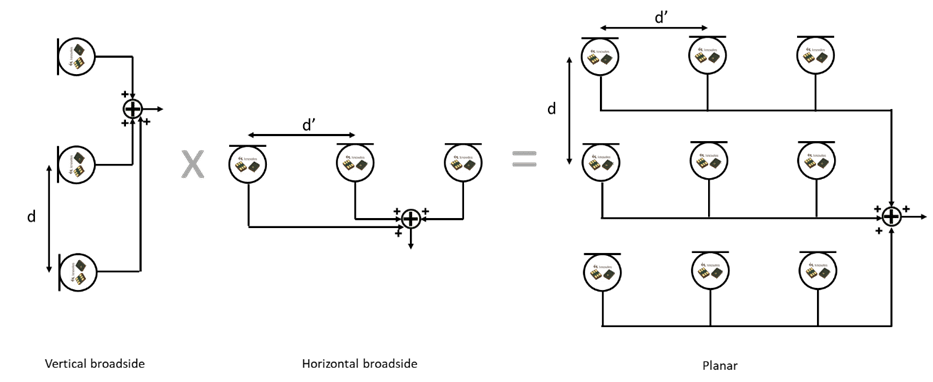
As shown in Figure 1, a planar array can be understood as a combination of two broadside beamformers arranged in a perpendicular way to one another. The resulting planar array will be “bidirectionnal” and orthogonal to the microphone’s plane.

Figure 1 – Planar array explained as a mix of two broadside arrays perpendicular to each other

Planar arrays show their full potential compared to a simple one-dimension beaformer when changing the number of microphones and/or the separation distance between rows and columns.

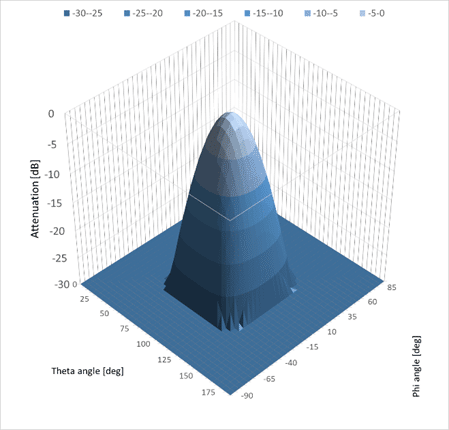
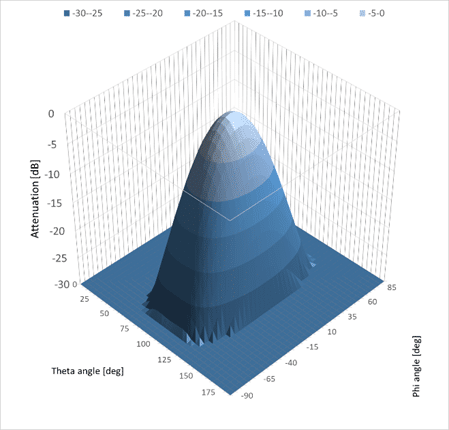
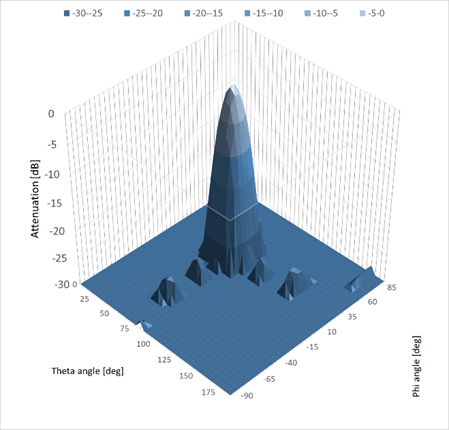
Figure 2 below illustrates the beam (3D directivity as a function of theta and phi) obtained at 1k Hz for a 4 x 4 microphones configuration with a 10 cm spacing between the microphones. Figure 3 shows an interesting way to enlarge the beam in one direction, by removing a row/column of 4 microphones, resulting in a rectangular array of 3 x 4 microphones.

Figure 2 - 1k Hz beam – Array of 4x4 microphones – dx=dy=0.1 m
Figure 3 - 1k Hz beam – Array of 3x4 microphones – dx=dy=0.1 m

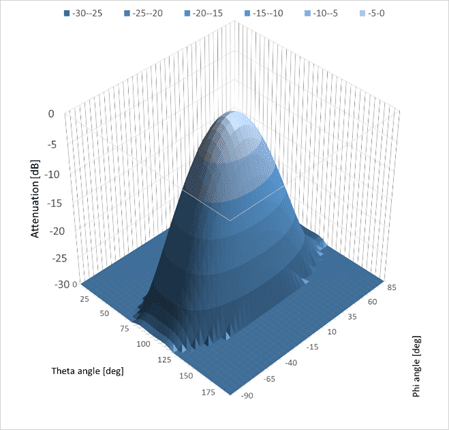
Figure 4 down below shows that a similar beam broadening can be achieved by playing with the spacing distance in one direction, resulting in a 4 x 4 array with a distance of 0.07m in one direction and of 0.1 m in the perpendicular direction.

Figure 4- 1k Hz beam – Array of 4x4 microphones – dx=0.07m,dy=0.1 m

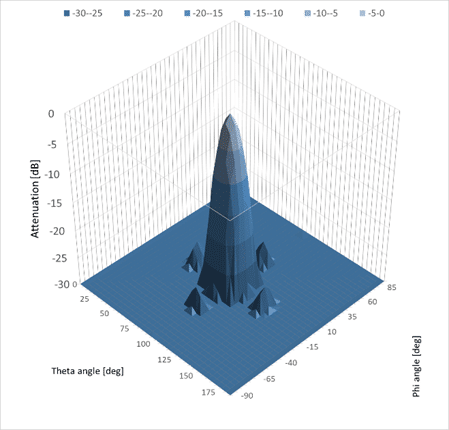
Another advantage of planar arrays over broadside configurations is the ability to steer the beam diagonally. In Figure 5 below, we can see the beam obtained at 2k Hz (for the same 4×4 microphone array) while Figure 6 shows the steering obtained by applying a phase shift of 25° in both directions.

Figure 5 - 2k Hz beam – Array of 4x4 microphones – dx=dy=0.1 m
Figure 6- 2k Hz beam – Array of 4x4 microphones – dx=dy=0.1 m phasetheta=phasephi=25 °

Are you looking to improve your directivity performance by moving from 1D to 2D beamforming? Let SELTECH support you in finding the best array configuration suited to your application.

Discover more about our acoustic department

Review by:

Frédéric Fallais, Acoustic Application Engineer

Arthur Di Ruzza, Acoustic Technician

PrevPreviousSensors converge 24 – Santa Clara, CA – June 24-26
NextSpeech Transmission Index: A proper way of evaluating the intelligibility of your systemNext

南京赛泰商贸有限公司

江苏省南京市鼓楼区南昌路40号长江科技园大厦2001

Tel EU : +33 1 48 92 90 02
Tel USA : +1 (919) 481 6896
Tel CN: +86 25 83 45 54 33

产品

  • 声学组件
  • 电容式多功能传感器
  • 处理器
  • 无线系统
  • 声学组件
  • 电容式多功能传感器
  • 处理器
  • 无线系统

服务

  • 声学设计服务
  • 工程设计与制造
  • 碳足迹
  • SPL 计算器
  • 加入我们
  • 声学设计服务
  • 工程设计与制造
  • 碳足迹
  • SPL 计算器
  • 加入我们

法律信息

  • 欧洲条款与条件
  • 美国条款与条件
  • 企业社会责任(CSR)
  • 法律声明
  • 欧洲条款与条件
  • 美国条款与条件
  • 企业社会责任(CSR)
  • 法律声明

© Copyright 2025 SELTECH, All Right Reserved.