Speech Transmission Index: A proper way of evaluating the intelligibility of your system
In audio applications where voice communication is an essential feature, it is important to ensure good intelligibility. Using the example of an audio playback system in a room, the understandability of a given speech played from this system depends on two factors:
The acoustic properties of the room,
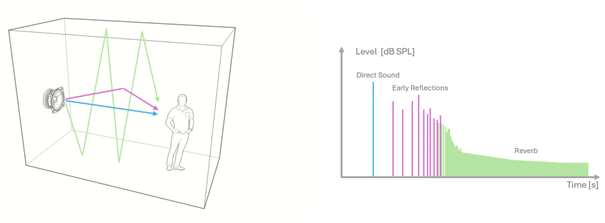
Considering a reverberant room (for example, a church), Figure 1 illustrates to what extent the listening distance from the sound source can affect the intelligibility of the signal played: if the listening distance remains relatively short, the direct energy from the source will dominate over early reflections and reverberation. On the other hand, if the listening distance is too long, the energy from reflected and reverberant fields will dominate, thus making speech incomprehensible.
Acoustic properties at the system level,
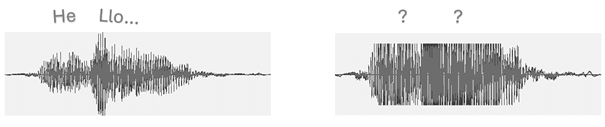
Many audio parameters such as reproduced bandwidth, signal-to-noise ratio, or distortion can also affect signal intelligibility. Taking distortion (or clipping) as an example, Figure 2 illustrates to what extent a saturated signal can alter the transmitted message (the word “Hello” considered in example here).
Figure 1 – Illustration of direct sound, early reflections, and reverberation in a room
Figure 2 – Illustration of the impact of saturation and clipping on a speech signal
From the above, we understand that evaluating intelligibility at the system level only will necessitate an anechoic environment to overcome room effects. Regarding the measurement protocol, the Speech Transmission Index (STI) method, proposed in most of the electroacoustic acquisition systems on the market is very popular in the industry. Based on the IEC 60268-16 standard, it relies on the principle of modulated transfer functions (MTF).
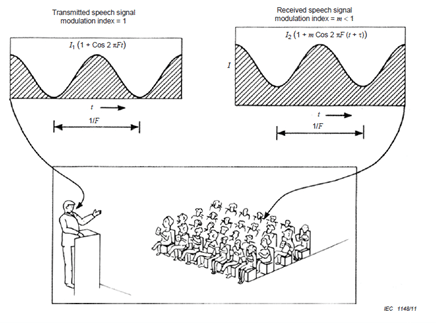
As Figure 3 illustrates, its concept arises from historical observations about speech. The separation of words, phonemes, and sentences leads to temporal and frequency fluctuations considered crucial for understanding. Any degradation of these modulations (during the signal’s travel to an audience) can thus lead to a loss of intelligibility. The STI protocol is directly inspired by these observations and uses amplitude-modulated measurement signals at different frequencies. The recording of these signals analyzes the extent to which the modulation is altered by the electroacoustic aspects mentioned above.
Figure 3 – IEC 60268-16 standard – Par. 4.2 – Background of the STI Method - “Figure 1 - Concept of the reduction in modulation due to a transmission channel”
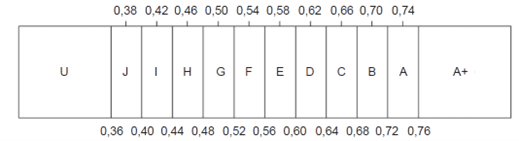
The STI final index is calculated from a set of MTFs leading to a score between 0 and 1, as shown in Figure 4. The higher the score, the greater the intelligibility.
Is intelligibility a fundamental aspect of your application? Let SELTECH support you in the design and evaluation of the best speech reproduction system.