

Designing a sealed speaker enclosure properly requires a solid understanding of acoustic principles, often relying on modelling techniques such as lumped elements or finite elements to accurately predict performance. However, for many practical applications, simplified methods can provide quick and effective estimates. In this post, we propose managing enclosure damping (Qtc) using only two basic inputs: the speaker’s total quality factor (Qts) and the equivalent compliance volume (Vas).
In many designs, the available volume for a speaker enclosure is often predetermined due to space constraints. Therefore, the first formula below (1) estimates the damping based on a known enclosure volume. It can also be reversed to estimate the volume required for a targeted damping value (2).

Or
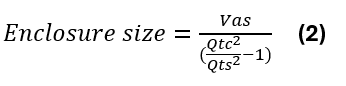
Where Vas and enclosure size are expressed in the same units (L or m³).
Once the damping is estimated, charts like the one shown in Figure 1 illustrate the sound pressure level for various enclosure damping values in relation to the enclosure resonant frequency (fc)
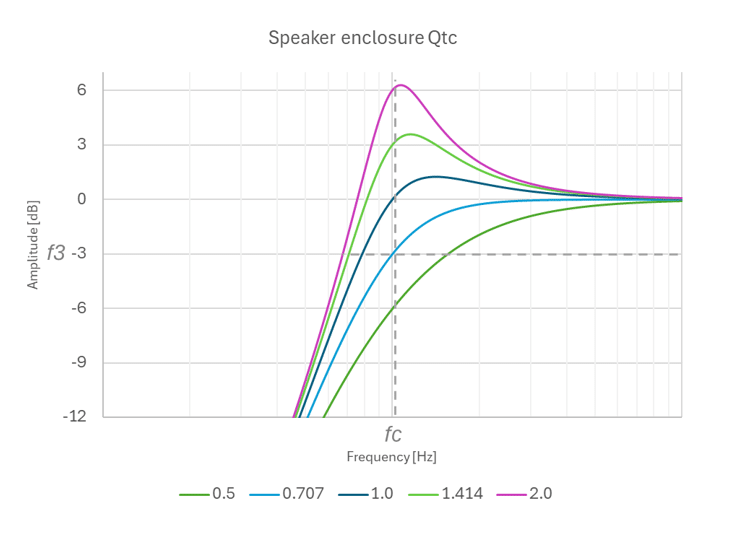
From the figure, we can see that the amplitude of the response at resonance varies significantly depending on the damping value. For low values (high damping), the response is quickly attenuated, while for higher values (low damping), the resonance tends to ring.
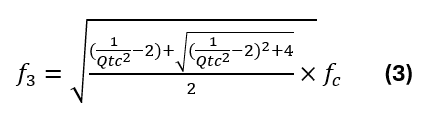
Additionally, depending on the damping value, there is a swap between fc and f3, the latter being defined as the frequency where the amplitude drops by 3 dB from the nominal level. For low damping, f3 is lower than fc, whereas for high damping, the opposite occurs. This observation highlights that f3 can sometimes be a better indicator for estimating the bandwidth of the enclosure.
As for Qtc, a simple formula (3) allows estimating f3 knowing both Qtc and fc.
Many online articles discuss the importance of Qtc for achieving good alignment in speaker enclosures. Notably, Marius Tanasescu offers valuable insights, highlighting how the chosen alignment affects the speaker’s transient response [1]:
- A Qtc around 0.5 offers excellent transient response but results in an over-damped speaker with lower efficiency.
- Most aim for a Qtc of 0.707 as it provides a good balance with solid transients.
- For Qtc values between 0.7 and 1.2, efficiency improves, though transient response slightly degrades and the roll-off becomes steeper.
- When Qtc exceeds 1.2, the system achieves high efficiency but suffers from poor transients due to an under-damped response.
Do you need a complete speaker enclosure design tailored to your specific needs? Contact Seltech for expert guidance and solutions. Let our team help you achieve the perfect balance of performance and efficiency.
Review by:
Frédéric Fallais – Acoustic Application Engineer, SELTECH
[1] M. Tanasescu, “Sealed Enclosure Explained in Detail and Calculator,” January 25, 2016. [Online].
Available: https://audiojudgement.com/sealed-enclosure-closed-box/ [Accessed September 16, 2024].