


Boom microphones are essential for clear communication in applications like gaming, military, aviation, or workplace environments. Their ability to deliver intelligible speech without distortion or noise interference is crucial for seamless teamwork and avoiding miscommunication.
Evaluating a boom microphone’s performance starts with understanding its frequency response. A well-balanced response ensures natural and clear speech, while an uneven one can lead to muffled or harsh audio. When combined with good directivity, it also minimizes background noise, ensuring clarity even in noisy environments.
Whether you’re an audio engineer or a product tester, this short post proposes a simple and effective laboratory method to check the frequency response of your boom microphone.
Key components for accurate testing include:
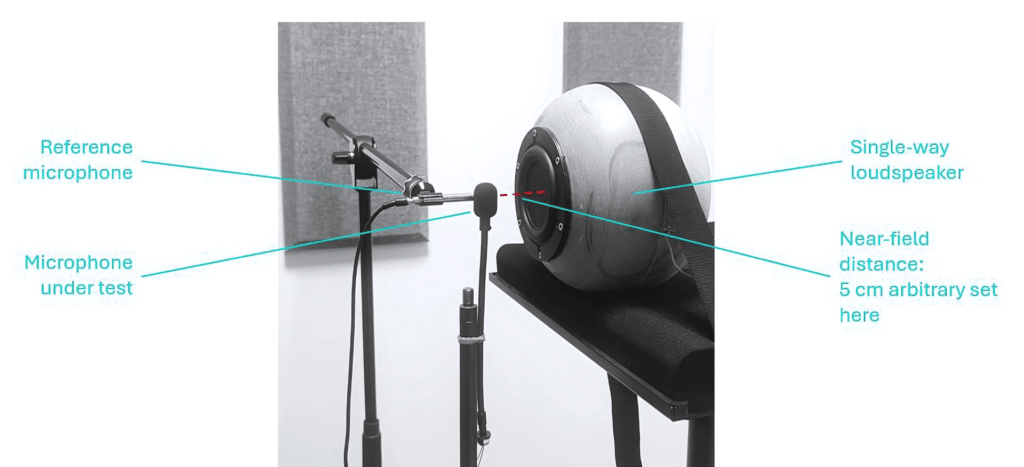
- A suitable environment, not necessarily an anechoic chamber, but a space large enough to minimize wall reflections by positioning the setup away from surfaces,
- A high-quality amplified speaker system capable of reproducing a wide audio bandwidth with minimal deviation. A monopole (single-way) design is ideal, allowing placement close to the microphone to evaluate the near-field response, reflective of use case scenarios,
- A reference microphone, preferably from the acoustic measurement domain (e. g. GRAS Sound & Vibration 46BE) or professional music industry category, to provide accurate and reliable reference for the captured audio field.
Figure 1 below illustrates such a setup, where we propose to evaluate the response of a dynamic boom solution from the Knowles Corporation product range.
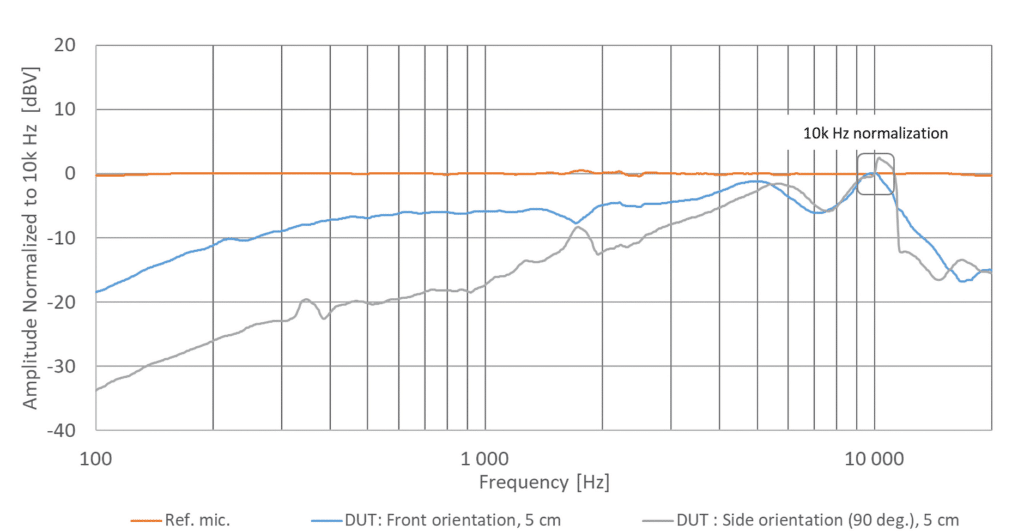
This boom being directive, the graph in Figure 2 reports the near field response for two different orientations to the sound field: front port exposed (0 deg.) and side port exposed (90 deg.).
The field captured from the reference microphone is verified to be flat.
The two responses are equal at 10 kHz, so normalization is applied at this frequency to better evaluate deviations at other frequencies.
Observing the response for the front orientation, we see that it remains rougly within 10 dB from 200 Hz to 13.5 kHz. Since adult human speech typically spans 70 Hz to 8 kHz, this bandwidth is understood sufficient for voice capture.
However, when side-oriented to the field, we see the response dropping significantly at low frequencies as a result of the microphone’s directivity properties.
This microphone behavior ensures background noise (coming from other directions in the far field) to be attenuated, enhancing so the clarity of speech signals coming from the front.
Have you designed a boom microphone for your application and need to evaluate its performance? Let Seltech help you optimize its integration for the best possible results!